

Thought for the week - 31 May 2026
Where are we going and what can I do about it? What can you do about it? Better to ask ‘what can we do about it’. What can Trinity Sunday teach us today? First, in Christ we discover that God is love. It is not just that God loves, but that God is, at the very core of his being, love. When we love, we share in the life of God. If God were alone from all eternity, then God could not be love. There would have been no one and nothing to love until Creation. Love would be accidental to God and so God could stop loving as he had once begun. But because our God indeed is love, then we are caught up in this mystery and, like all people from all lands, nations and times we may dare to cry out ‘Abba, Father!’
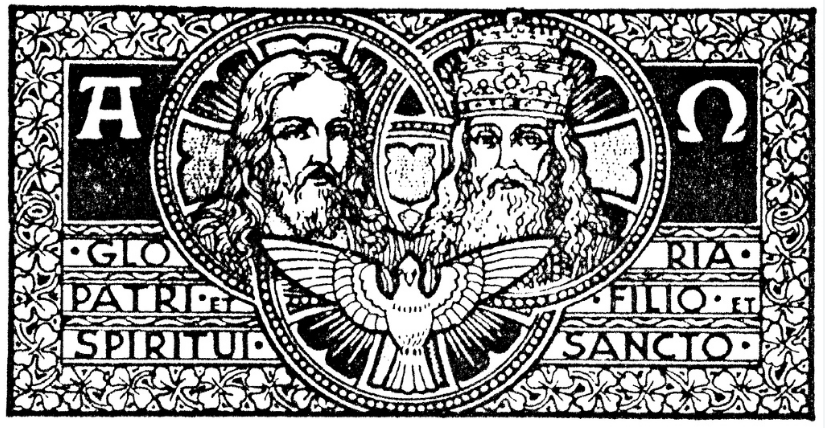
Maybe that is all we need to know, but it does not unpack the meaning of Trinity Sunday very well and the Trinity is not shown by going to heaven and counting the persons of the Trinity. It points towards a love which is utterly mutual but which overflows, as the love of the Father and the Son overflows in the Holy Spirit. When parents have children, they too learn that love which overspills beyond the couple. Love becomes Trinitarian as its mutuality is opened towards others. Otherwise our loves might become introverted and narcissistic. So the doctrine of the Trinity is not abstract celestial mathematics. It is the most down-to-earth practical lesson in the mystery of generous and fruitful love. It is beautiful, because love is beautiful, and it needs to be said again and again because of that challenging line we just heard, ‘whoever does not believe stands condemned already because they have not believed in the name of God’s one and only Son’ John goes on to explain that there are those who prefer the darkness to the light, and so will follow the voice of the devil and not the gentle loving voice of God. God is a love which is completely one. What can we do about the mess we are in? Point to God. Show people where love is perfected and freely available, living our lives in the light of truth as given to us in scripture.
This is the glorious doctrine of the simplicity of God, and right from the earliest times, the disciples had a glimpse of the mystery of this Triune love which they encountered in Jesus. This is not the belief in some strange divine threesome on a remote planet. It is the love which transfigures our own loving. All our everyday ordinary loving is marked with this mystery. It is a love which lifts us into equality, as the Father, Son and Holy Spirit are equal. Its grace frees us from domination and manipulation. It is a fertile love, overflowing beyond itself. It draws us into unity with each other and with God, overthrowing divisions between nations, saints and sinners, the living and the dead. Our love is pregnant with the prayer of Jesus, addressed to his Father and ours, ‘that they may be one even as we are one, I in them and thou in me, that they may become perfectly one.’
It can seem that that two is a natural number for community. If there are two people there is community, if they belong to one another, they are somehow fulfilled in the way that no solitary person is. We think of two as the natural number, in fact Plato thought that it was the first number, since one is meaningless as a number unless there is one more of the same sort with which to be compared.
Even in larger groups, it resolves itself into two. Politics that works tends to resolve itself into two parties, Conservative and Labour, Republican and Democrat, and if you want to give other examples for other countries, I did say ‘politics that works’. Opinions boil down to two options, teams play one another. Either we are alone or we are in a relation to another, even a negative relation where there is anger, or hatred. In wars too, the complexities resolve themselves into two sides against each other, and others take sides behind one or the other. Yet the teaching of Christianity, its deepest conviction, is that three is the true number of relationship, not two. How can that be?
In fact the answer is quite simple. Jesus said ‘Where two or three are gathered in my name, I am there among them’. What he is saying is that if there are two gathered together, there is also, by the nature of things, three. The two can only be two because there is between them a relationship, and this is the third thing.
In our world, not all relationships are relationships of love. We can be bound to one another by hatred, by competition, by anger. Yet even there, it is love that lurks at the heart of things. We hate people because we want them to be objects of love. We hate them because we want to love them but cannot. There is nearly always a germ of love to be found in great hatred, a love which is never quite extinguished, which is also what we can do – we can search for the image of God in those we are opposed to, and love that image because it would be self-harm, as Christians, not to do so.
Of its nature, there is indeed no past tense in the verb ‘to love’. The Trinity is the proof of this. In our world, lots of things are alienated from their own nature. Lots of things are, in the deepest sense, not quite themselves. This is why we seek redemption. This is why the Holy Trinity is the sign of our redemption. With them, the two are always three, because the two are always in love, and love is in them, and one day, by their grace, there will be love for all, without a past tense, because we will dwell forever in the love that finds its image in God, to whom we will go if we live in the light and not the darkness. God is love, and those who live in love live in God and God dwells in them, and there is only one God, who is Father, Son and Holy Ghost.


Qué número es tu sueño está explicado con claridad y de manera sencilla. Encontré rápidamente la información que buscaba gracias a la buena organización del contenido. Me pareció un recurso práctico para consultar diferentes interpretaciones relacionadas con los sueños.
A profound commentary on God's love on the Feast of the Holy Trinity. Recognizing His nature as love helps us find our way through a turbulent world. When we share love together, we are like deciphering a sacred puzzle that is incredibly interconnected—natural and inseparable, much like finding the keywords in a Quordle game. A truly thought-provoking perspective!
Players gradually develop better pattern recognition skills as they progress through the increasingly difficult stages of Coreball.
The level design in Drive Mad encourages experimentation. Sometimes the solution is less about speed and more about finding the right balance.